



How can the measles risk map reveal ZIP code vaccination danger in US cities and states across
Interactive measles risk map allows US families to check ZIP code vaccination levels, identify outbreak hot spots in cities and states, and understand local measles danger using scientific estimates.
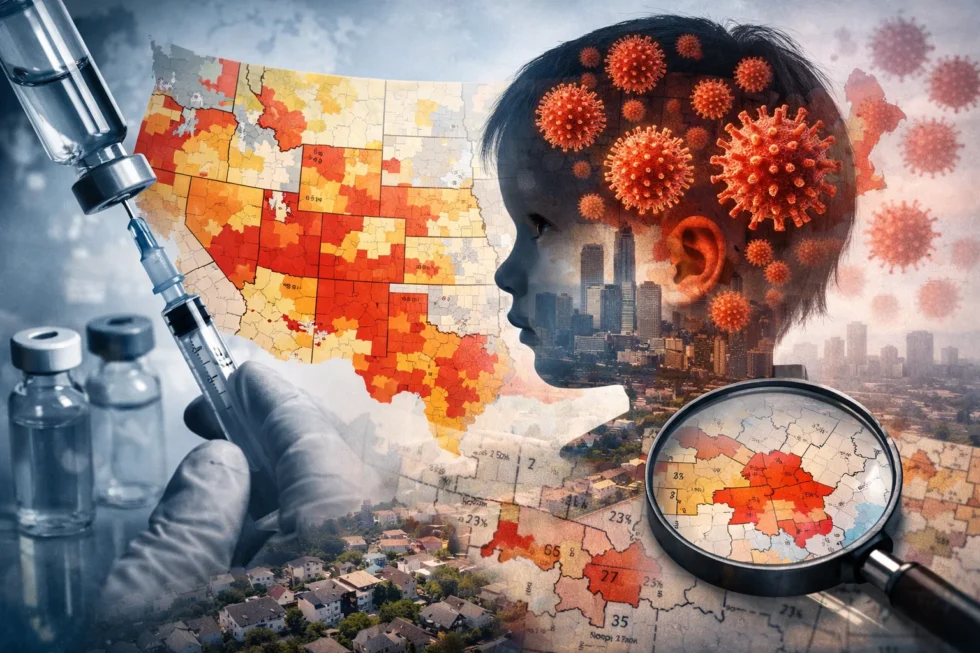
A new public health tool known as the measles risk map was launched in the United States on 15 January 2026, giving families the ability to check local vaccination levels by entering a ZIP code. The interactive map was created by medical researchers from Boston Children’s Hospital, Harvard Medical School and the Icahn School of Medicine at Mount Sinai as part of a nationwide study into falling immunisation rates. Published alongside their findings in the journal Nature Health, the tool provides the first detailed county- and neighbourhood-level estimates of protection against measles, one of the most contagious viruses in the world. It identifies “hot spots” where vaccination coverage is dangerously low and outbreaks are more likely to occur.
The launch comes as confirmed measles cases in the United States have reached a 33-year high, prompting health officials to warn that many communities remain below the 95% vaccination threshold needed for full protection. Researchers say the map is designed to help parents, doctors and policymakers understand exactly where the risks are greatest and where urgent action is required. Reports San Francisco Newsroom, citing primary media sources on the topic.
What is the measles risk map and how does it work
For the first time, members of the public can enter their ZIP code into an online platform and receive an estimate of the percentage of children in their area who have received at least one dose of the measles, mumps and rubella (MMR) vaccine. The tool was developed through collaboration between researchers at:
- Boston Children’s Hospital
- Harvard Medical School
- Icahn School of Medicine at Mount Sinai
Their findings were published this week in the scientific journal Nature Health. The system analyses anonymised vaccination data and uses statistical modelling to generate local estimates. Areas are then grouped into five clear risk categories, from “lowest risk” to “very high risk”.
Risk categories explained
| Risk category | Estimated vaccination coverage | What it means |
|---|---|---|
| Lowest risk | 85% or more | Strong community protection |
| Low risk | 80–84% | Generally protected |
| Medium risk | 70–79% | Outbreaks possible |
| High risk | 60–69% | Serious vulnerability |
| Very high risk | Under 60% | Outbreaks highly likely |
Researchers use the terms “hot spots” for areas with low coverage and “cold spots” for places where vaccination levels remain high.
Why are measles cases rising so sharply
The United States is currently experiencing its worst measles situation since 1992. Official figures from the Centers for Disease Control and Prevention (CDC) show:
- 2,242 confirmed cases in 2025
- Infections recorded across 44 states
- Nearly 50 separate outbreaks last year
- Around 93% of cases occurred in people who were unvaccinated or had unknown vaccination status
Medical experts warn that declining immunisation rates are directly responsible.
“There are many communities around the country that are nowhere near the required thresholds of vaccination,” said Dr John Brownstein, epidemiologist and co-author of the study. “This map gives us an unfortunate sort of crystal ball into the future of where we’ll see these future outbreaks.” (Interview with ABC News, January 2026) Public health guidance states that at least 95% coverage with two doses of MMR vaccine is needed to prevent measles from spreading.
Where are the current measles hot spots
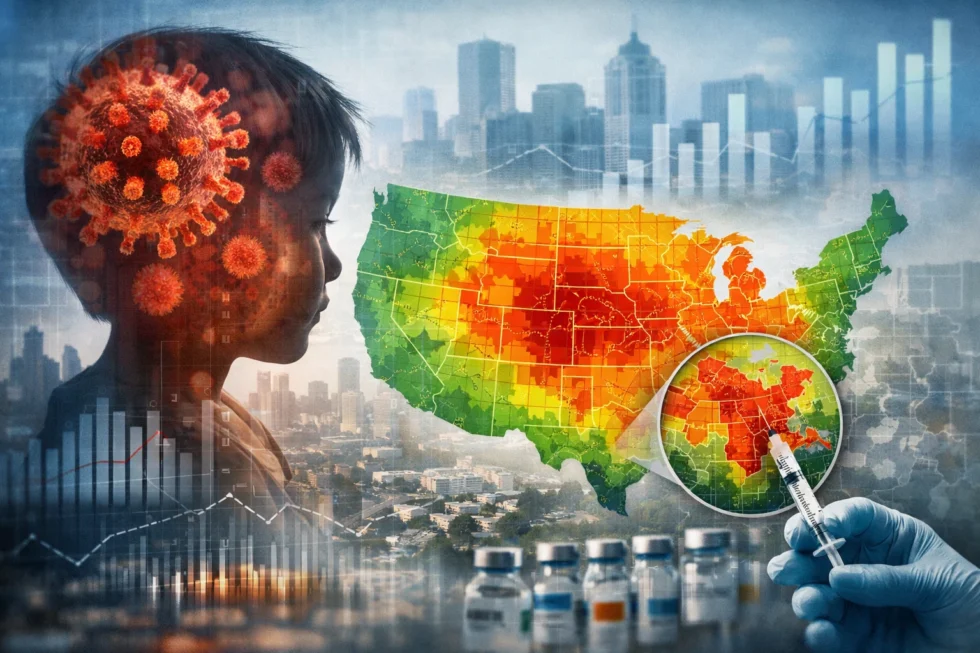
According to the analysis, the highest-risk regions are concentrated in:
- West Texas
- Southern New Mexico
- Parts of Mississippi
- Rural areas across the south-eastern United States
These locations have already experienced significant outbreaks in recent years.
Examples of high-risk counties
| County | State | Risk level | Vaccination estimate |
|---|---|---|---|
| Gaines County | Texas | High risk | 60–69% |
| Lea County | New Mexico | Very high risk | Below 60% |
| Several Mississippi counties | Mississippi | High to very high | Below 70% |
Gaines County was the epicentre of a major Texas outbreak in 2025, while Lea County in New Mexico recorded some of the lowest vaccination levels in the nation. Tragically, last year also saw three measles deaths – two unvaccinated school-age children in Texas and one unvaccinated adult in New Mexico – the first US fatalities from the disease in a decade.
Which areas are better protected
The study found that “cold spots” with high vaccination coverage are largely located in:
- The north-eastern United States
- Parts of the Upper Midwest
In Maine, for example, every county recorded at least 70–79% coverage among young children, placing the state in the medium-to-low risk range.
“We know that outbreaks are highly local,” Dr Brownstein explained. “To be able to respond to an outbreak that is highly localized, you need highly localized data, and this is really a first-of-a-kind study to do this.” (ABC News interview, January 2026)
Why does community vaccination matter so much
Measles is exceptionally contagious:
- One infected person can spread the virus to nine out of ten unvaccinated people
- The virus can linger in the air for up to two hours
- Even brief contact can result in infection
This is why experts emphasise the importance of herd immunity – the concept that when enough people are vaccinated, the disease cannot easily circulate.
“If you’re surrounded by a lot of people who aren’t vaccinated, you’re at much greater risk,” said Dr Paul Offit, director of the Vaccine Education Center at Children’s Hospital of Philadelphia. (Previous interview with ABC News) Research from an early 2000s outbreak in the Netherlands showed that unvaccinated individuals were 224 times more likely to contract measles than vaccinated people.
Declining vaccination rates among children
The release of the measles risk map comes amid worrying national trends. CDC data indicates that:
- MMR vaccination among US kindergarteners has fallen from 95.2% in 2019 to 92.5% today
- Nearly 300,000 children entering school are now unprotected
- Non-medical vaccine exemptions have risen sharply to 3.1%
Dr Eric Zhou, assistant professor at Mount Sinai and co-author of the research, said the goal is to provide clearer information to families.
“We certainly hope, with all of this new information, parents can make more informed decisions about their children’s vaccination,” Zhou told reporters. (ABC News, January 2026)
Limitations of the tool
Researchers stress that the measles risk map is not perfect.
- Estimates are based on modelling rather than exact counts
- Some data includes children too young to be vaccinated
- Individual risk can differ from community risk
However, scientists believe it remains a powerful guide for both the public and government agencies.
“Hopefully this will help provide more up-to-date, more localized information for everyone to make the best decisions,” Zhou added.
What families can do now and why it matters
Public health officials say the measles risk map is intended as a practical guide for parents and carers to make informed decisions about their children’s health. Doctors and vaccination experts recommend four clear steps that families can take immediately.
Recommended actions
- Check local protection levels by entering your ZIP code into the measles risk map to see how well your community is vaccinated.
- Ensure children receive both scheduled doses of the MMR vaccine on time, as full protection requires two injections.
- Speak to a GP or paediatrician if you are unsure about a child’s vaccination history or need to catch up on missed doses.
- Avoid delaying routine immunisations, particularly for young children, as even short gaps in coverage can increase the risk of infection.
Health authorities stress that these measures are especially important at a time when measles cases in the United States are rising sharply and vaccination rates in many areas are falling below safe levels.
Why this guidance is useful
The purpose of the tool is not to create alarm but to provide families with clear, local information. Knowing whether you live in a high-risk or low-risk area can help parents decide how urgently to update vaccinations, whether to seek medical advice, and how cautious to be during local outbreaks.
Although the map currently focuses on American ZIP code data, British public health experts note that the same principles apply in the United Kingdom. Communities with high MMR uptake remain well protected, while neighbourhoods where vaccination coverage has declined face a greater risk of renewed measles outbreaks.