


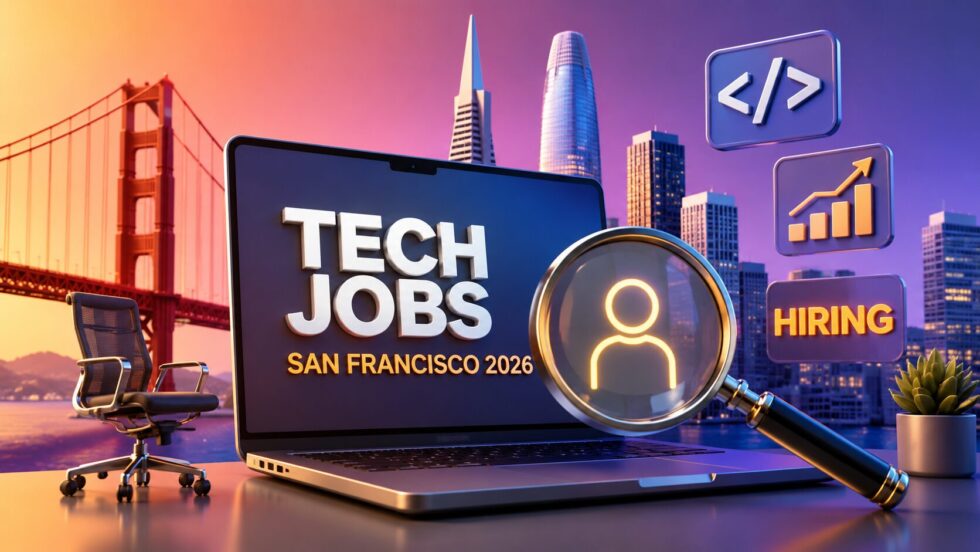
Tech Jobs San Francisco 2026: Who Is Hiring Right Now as AI Reshapes Silicon Valley
Tech jobs San Francisco 2026 are shifting fast as AI firms, cloud companies and cybersecurity startups keep hiring despite layoffs at Meta and Amazon. Here is who is recruiting now.

Tech jobs San Francisco 2026 are no longer defined by the old Silicon Valley model where mass hiring automatically followed venture capital growth. The Bay Area hiring market has split into two realities at the same time: thousands of layoffs across traditional corporate tech teams and aggressive recruitment inside artificial intelligence, cloud infrastructure, cybersecurity and automation companies. Employers in San Francisco are now paying premium salaries for machine learning engineers, AI product managers, data infrastructure architects and enterprise sales specialists with technical backgrounds, while mid-level operational and administrative roles are shrinking across the region. Recruiters say the market has become dramatically more selective compared with 2021 and 2022, particularly for generalist positions. Several large firms including Meta, Intuit, Autodesk and Workday continued restructuring in 2026 while simultaneously expanding selected AI-focused divisions, a contradiction that now defines the Bay Area economy. The result is a hiring landscape where some candidates receive multiple offers while others remain unemployed for months despite strong résumés, as San Francisco Newsroom reports from the center of the current San Francisco technology transition.
San Francisco’s technology economy is also becoming more concentrated around infrastructure rather than consumer growth alone. Venture capital money in 2026 is flowing heavily into AI model optimization, robotics software, defense technology, enterprise automation, semiconductor systems and cybersecurity platforms. Recruiters across the Bay Area report that companies increasingly prefer candidates who combine technical expertise with communication and business execution skills rather than narrow engineering specialization. Hiring managers are asking for employees who can work across AI implementation, compliance, customer operations and product deployment simultaneously. At the same time, competition for senior AI talent has intensified salary pressure throughout the region, especially around downtown San Francisco, South of Market and parts of Palo Alto.
Which companies are hiring in San Francisco right now
The strongest recruitment activity in San Francisco during 2026 is concentrated inside artificial intelligence infrastructure, developer tools, enterprise SaaS, cloud computing and cybersecurity. While layoffs dominate headlines, many firms continue expanding highly targeted departments connected to AI monetization and enterprise automation.
Companies actively recruiting in or around San Francisco include major AI laboratories, cloud infrastructure firms, enterprise software companies and growth-stage startups. Open positions increasingly focus on revenue-generating technical roles rather than broad hiring across all departments. Employers are also prioritizing hybrid candidates who understand both engineering and operational scaling.
Several firms have reduced overall headcount while continuing recruitment in strategic areas. Meta, for example, has reorganized thousands of positions around AI development despite broader cuts. Intuit is restructuring around automation and generative AI integration while still expanding selected engineering and product divisions. Autodesk continues investing in AI and cloud infrastructure after relocating its headquarters to San Francisco.
Most active hiring categories in San Francisco tech
| Sector | Most requested roles | Hiring trend in 2026 |
|---|---|---|
| Artificial intelligence | ML engineers, AI researchers, prompt engineers | Very strong |
| Cybersecurity | Security analysts, threat engineers | Growing rapidly |
| Enterprise SaaS | Product managers, cloud architects | Stable to strong |
| Robotics & automation | Robotics software developers | Expanding |
| Fintech infrastructure | Compliance engineers, fraud systems | Selective growth |
| HealthTech | AI diagnostics, data analysts | Moderate growth |
| DevTools & infrastructure | Backend engineers, systems architects | Strong |
The strongest demand is concentrated around senior-level engineering roles linked to AI infrastructure. Companies are spending less on experimental consumer apps and more on technologies capable of reducing operational costs or increasing automation efficiency.
Roles companies are struggling to fill
Recruiters across San Francisco repeatedly mention shortages in several highly specialized categories:
- AI infrastructure engineering
- GPU systems optimization
- Enterprise cybersecurity
- Data governance for AI systems
- AI compliance and regulation
- Technical B2B sales for AI software
- Applied machine learning in healthcare
- Cloud security architecture
Many employers also report difficulty finding candidates who can explain complex AI products to enterprise clients. This has created unusually high demand for technical account executives and AI-focused sales engineers.
Why layoffs and hiring are happening at the same time
The San Francisco technology market in 2026 is not collapsing uniformly. Instead, companies are reallocating spending toward AI-driven operations while reducing older organizational structures. This explains why headlines about layoffs appear simultaneously with reports about aggressive hiring for specialized technical teams.
According to industry layoff trackers, more than 100,000 tech jobs have already disappeared globally during 2026, with artificial intelligence frequently cited as a major restructuring factor.
Yet this does not mean hiring has stopped. Many firms are replacing broad middle-management structures with smaller technical units focused on automation, AI integration and infrastructure performance. Companies increasingly want smaller teams capable of producing higher output through AI-assisted workflows.
A growing divide is emerging between workers directly connected to AI implementation and employees whose tasks can partially be automated. This trend is particularly visible in San Francisco because the city remains the global center of venture-funded AI development.
“The job search has been brutal,” former Google account manager Basem Istanbouli told the Los Angeles Times in May 2026 while describing months of unsuccessful applications despite extensive experience in Silicon Valley.
The pressure is also changing employee psychology inside the Bay Area. Many workers now prioritize job stability, remote flexibility and equity quality rather than simply joining famous brands.
AI jobs are driving the new San Francisco salary boom
Artificial intelligence hiring has created a new compensation structure inside the Bay Area economy. Salaries for experienced AI engineers, infrastructure specialists and machine learning architects have surged again during 2026, especially among companies competing directly with OpenAI, Anthropic and enterprise AI platforms.
Some venture capital discussions inside San Francisco increasingly describe the emergence of a “two-tier tech economy” where elite AI specialists receive compensation packages far above traditional software engineering salaries.
Estimated salary ranges in San Francisco tech 2026
| Position | Estimated annual compensation |
|---|---|
| Senior AI engineer | $280,000–$650,000 |
| Machine learning architect | $250,000–$500,000 |
| Cybersecurity lead | $190,000–$350,000 |
| Product manager AI systems | $220,000–$400,000 |
| Cloud infrastructure engineer | $210,000–$360,000 |
| Technical AI sales executive | $180,000–$450,000 |
| Mid-level software engineer | $130,000–$210,000 |
Compensation depends heavily on equity packages and company valuation. Some AI startups now offer smaller salaries but extremely aggressive equity incentives in expectation of future acquisitions or IPOs.
At the same time, non-specialized technology positions have become significantly more competitive. Recruiters report rising applicant numbers for standard frontend development, customer success and operational support roles.
San Francisco startups are still recruiting despite uncertainty
Startup hiring in San Francisco has slowed compared with the pandemic-era expansion cycle, but the market remains highly active around AI infrastructure, robotics, health technology and cybersecurity.
Early-stage startups increasingly prefer small expert teams rather than rapid scaling. Founders are focusing on profitability and operational efficiency earlier than in previous cycles. Investors are also demanding clearer revenue models before approving large hiring expansions.
Several areas attracting strong investment interest include:
- AI automation for enterprise operations
- Defense technology
- Medical AI systems
- Legal technology automation
- Robotics software
- Financial compliance AI
- AI-powered cybersecurity
- Vertical SaaS for logistics and healthcare
Many startups are now recruiting globally while maintaining executive leadership and product strategy teams in San Francisco.
What startup founders want from candidates in 2026
The hiring profile has changed significantly across the Bay Area startup ecosystem. Employers increasingly prioritize adaptability and execution speed over prestige alone.
Recruiters frequently mention these candidate advantages:
- Experience with AI-assisted workflows
- Ability to work cross-functionally
- Startup operational experience
- Strong communication skills
- Product thinking alongside technical execution
- Revenue-oriented decision making
- Experience deploying enterprise AI systems
Founders are also placing more emphasis on employees capable of working directly with clients rather than remaining isolated inside technical departments.
Remote work is still reshaping the Bay Area market
Remote and hybrid work remain central to the San Francisco hiring discussion in 2026. Many companies continue reducing office footprints while simultaneously increasing selective in-person collaboration expectations.
The Bay Area no longer dominates technology hiring geographically the way it did before 2020. Companies are recruiting from Austin, Miami, Seattle, Toronto, London and Eastern Europe while keeping leadership and venture operations concentrated in San Francisco.
However, proximity to Silicon Valley still matters for networking, fundraising and senior-level recruitment. Many venture capital firms continue preferring founders who maintain visible presence inside the Bay Area ecosystem.
The hybrid reality has also intensified competition for local candidates. San Francisco workers are now competing not only against neighboring engineers but against global talent pools.
Areas where in-person presence still matters most
| Function | Importance of physical presence |
|---|---|
| Venture capital networking | Very high |
| Enterprise AI sales | High |
| Executive leadership | High |
| Early-stage startup collaboration | Moderate to high |
| Backend infrastructure work | Lower |
| Remote cybersecurity operations | Lower |
| Customer support operations | Low |
Recruiters say networking remains a decisive factor for executive and founder-level opportunities throughout Silicon Valley.
Cybersecurity and infrastructure are becoming safer career bets
While generative AI dominates headlines, cybersecurity and cloud infrastructure continue offering some of the most stable hiring conditions in San Francisco technology.
Companies across finance, healthcare and enterprise SaaS are increasing spending on security operations due to growing regulatory pressure and expanding AI deployment risks. Cybersecurity hiring has remained more resilient than many consumer technology segments during the current restructuring wave.
Infrastructure engineering is also becoming increasingly valuable because AI systems require enormous computational efficiency and cloud optimization.
Industry analysts note that companies are willing to delay consumer product expansion before reducing cybersecurity spending, especially after recent global attacks targeting enterprise systems.
Why cybersecurity demand keeps rising
Several structural factors continue supporting cybersecurity recruitment:
- AI-generated cyber threats
- Regulatory pressure
- Enterprise cloud migration
- Healthcare data protection
- Financial compliance requirements
- Remote workforce vulnerabilities
- Infrastructure complexity
This trend has created sustained demand for both experienced security architects and junior analysts entering the field.
Universities and public institutions are hiring tech workers too
Not all technology hiring in the Bay Area comes from venture-backed startups or Big Tech firms. Universities, healthcare systems and public institutions are expanding technical teams connected to digital infrastructure, research computing and cybersecurity.
The University of California system recently saw thousands of technology workers unionize amid concerns about workload increases and AI-related restructuring.
Public-sector technology jobs generally offer lower salaries compared with Silicon Valley startups but often provide stronger long-term stability, pension systems and healthcare benefits.
Healthcare technology also remains one of the more stable sectors because hospitals and medical research institutions continue modernizing digital systems.
Which tech skills are actually getting interviews in San Francisco now
The biggest mistake candidates make in San Francisco during 2026 is applying with “classic tech résumés” built around generic software development without clear specialization. Recruiters across the Bay Area increasingly filter applicants through AI-related keywords, infrastructure experience and business impact metrics before interviews even begin. Companies are no longer impressed only by experience at famous firms. They want measurable results tied to automation, cloud performance, cybersecurity protection or enterprise AI deployment. This shift is especially visible inside AI-native startups and infrastructure companies where hiring managers often review hundreds of applications per role within days. Candidates who combine technical expertise with communication skills are consistently moving faster through interview pipelines than specialists unable to explain operational impact. In many cases, recruiters now prioritize practical deployment experience over academic prestige alone. The strongest hiring activity remains concentrated around AI engineering, cybersecurity, DevOps, cloud systems and enterprise automation.
A growing number of San Francisco employers also want candidates who already understand AI-assisted workflows. Recruiters say this now includes familiarity with coding copilots, automation systems, AI testing environments and prompt optimization for enterprise software operations. Several hiring managers report that candidates who openly demonstrate AI workflow integration inside portfolios and case studies are moving through interviews faster than applicants presenting traditional engineering portfolios.
Skills currently dominating Bay Area hiring pipelines
| Skill area | Demand level | Why companies want it |
|---|---|---|
| AI infrastructure | Extremely high | Core expansion area |
| Cybersecurity + AI | Very high | Rising AI-related threats |
| Cloud optimization | High | AI systems require scale |
| DevSecOps | High | Compliance and automation |
| Enterprise AI integration | High | Revenue-focused deployment |
| Data governance | Growing | Regulatory pressure |
| AI product management | Strong | Monetization focus |
| Technical enterprise sales | Strong | B2B AI expansion |
Companies are also paying closer attention to engineers who understand cost efficiency. GPU optimization, inference reduction and scalable AI deployment are becoming major competitive advantages because infrastructure expenses for large AI systems remain extremely high.
OpenAI, Anthropic and AI startups are reshaping hiring standards
San Francisco’s hiring market is increasingly influenced by the aggressive recruitment strategies of AI firms including OpenAI, Anthropic and fast-growing infrastructure startups. These companies are driving salary inflation across the city while simultaneously raising expectations for technical performance.
Anthropic recently expanded high-level AI recruitment by hiring former OpenAI co-founder Andrej Karpathy to strengthen its pre-training operations in San Francisco.
That type of hiring move sends signals across the broader Bay Area ecosystem. Smaller startups now compete not only for engineers but for AI researchers, deployment specialists and infrastructure architects capable of scaling large language models in production environments.
What AI companies increasingly ask during interviews
Recruiters and candidates describe several recurring interview themes inside San Francisco AI firms:
- Real-world AI deployment experience
- Infrastructure scaling under pressure
- Model optimization efficiency
- AI safety awareness
- Enterprise integration knowledge
- Communication with non-technical teams
- Rapid experimentation workflows
- Security and compliance understanding
Companies also increasingly test operational thinking rather than pure coding performance. Candidates may be asked how they would reduce inference costs, optimize enterprise AI adoption or secure sensitive datasets inside production systems.
Cybersecurity became one of the safest sectors in tech
While social media, consumer apps and advertising technology remain volatile, cybersecurity continues to show stable hiring activity throughout San Francisco and the Bay Area. Employers across healthcare, finance, AI infrastructure and cloud computing are increasing security budgets because AI-generated threats are growing more sophisticated.
Job platforms currently show hundreds of open cybersecurity positions across San Francisco, including AI security, cloud defense, incident response and compliance-focused engineering roles.
Palo Alto Networks CEO Nikesh Arora recently argued that AI will likely increase demand for engineers rather than reduce it entirely, particularly around infrastructure and cybersecurity expansion.
Cybersecurity roles hiring strongly in 2026
| Position | Why demand is increasing |
|---|---|
| AI security engineer | Protection against AI misuse |
| Cloud security architect | Enterprise cloud migration |
| Threat intelligence analyst | Automated attacks growing |
| DevSecOps engineer | Secure deployment pipelines |
| Security compliance lead | New regulations |
| Incident response manager | Infrastructure risks |
| Identity management specialist | Hybrid workforce expansion |
The strongest salary growth inside cybersecurity currently appears around AI-focused protection systems and enterprise cloud defense. Employers increasingly want engineers capable of understanding both traditional cyber threats and AI model vulnerabilities.
Several Bay Area recruiters say AI security is becoming one of the fastest-growing hybrid professions in Silicon Valley.
Why enterprise sales and AI communication jobs are suddenly valuable
San Francisco’s AI boom is not benefiting engineers alone. Companies increasingly need employees capable of explaining complex AI products to enterprise customers, healthcare systems, banks and government organizations.
This has created strong hiring demand for technical account executives, solutions engineers and AI-focused enterprise sales teams. Recruiters say many startups now struggle more to hire technical communicators than developers themselves.
The market is shifting because enterprise clients want practical business results rather than abstract AI demonstrations. Companies therefore prioritize candidates capable of translating technical infrastructure into operational value.
New hybrid roles growing in San Francisco
- AI solutions consultant
- Forward deployed engineer
- AI implementation strategist
- Technical AI account executive
- AI workflow operations manager
- Enterprise AI integration specialist
- AI infrastructure partnerships lead
Business Insider recently described these positions as part of an emerging “new class of AI jobs” appearing across the technology sector.
Several Bay Area startups are now specifically hiring candidates who combine product thinking, enterprise communication and operational deployment experience instead of separating those functions into isolated departments.
Startup hiring is becoming smaller but more selective
The old Silicon Valley growth model centered around massive scaling teams has weakened significantly during 2026. Startups are still hiring aggressively in San Francisco, but they now prefer smaller, high-performance teams capable of operating efficiently with AI-assisted systems.
Y Combinator’s current hiring ecosystem still lists hundreds of AI-focused startups actively recruiting in the Bay Area.
However, founders now evaluate candidates differently than during the venture capital boom years. Efficiency, execution speed and cross-functional adaptability matter more than resume prestige alone.
What founders now prioritize over prestige
| Old startup hiring logic | New 2026 hiring logic |
|---|---|
| Fast scaling | Lean execution |
| Brand-name experience | Practical impact |
| Broad headcount growth | Smaller expert teams |
| Growth at any cost | Operational efficiency |
| Consumer app expansion | Enterprise monetization |
| General software skills | AI-specific expertise |
Some startups now deliberately avoid large hiring waves because AI systems allow smaller engineering teams to maintain higher output than before.
Recruiters also report that founders increasingly want candidates comfortable with uncertainty and operational intensity rather than employees expecting structured corporate environments.
Remote work changed who competes for San Francisco jobs
One major reason Bay Area hiring feels more competitive in 2026 is global talent access. Companies no longer recruit only from California universities or Silicon Valley networks. Remote infrastructure and hybrid workflows allow startups to hire internationally while keeping leadership functions in San Francisco.
That means local workers now compete against global engineering talent, especially in backend infrastructure, cloud systems and AI development.
At the same time, proximity to San Francisco still matters heavily for:
- Venture capital networking
- Founder relationships
- Enterprise partnerships
- Executive recruiting
- AI conferences
- Startup ecosystems
- High-value business development
Many investors continue preferring founders physically present inside the Bay Area because decision-making and networking remain relationship-driven.
Where office presence still matters most
| Department | In-person importance |
|---|---|
| Venture capital | Extremely high |
| Executive leadership | High |
| Enterprise AI partnerships | High |
| Startup operations | Moderate |
| Infrastructure engineering | Lower |
| Cybersecurity operations | Lower |
| Remote DevOps teams | Low |
This hybrid reality is creating a divided labor market where some workers can operate globally while others still depend heavily on Silicon Valley proximity.
The pressure inside Big Tech keeps growing
Major technology firms including Meta, Intuit and Cloudflare continue restructuring around AI deployment and operational efficiency. Layoffs remain part of the broader transition as companies redirect spending toward automation and infrastructure modernization.
Meta recently eliminated around 8,000 jobs while simultaneously expanding AI divisions and increasing investment in AI infrastructure.
Cloudflare also announced major workforce reductions tied directly to an “AI-first operating model.”
Yet hiring has not disappeared entirely. Instead, companies are reallocating budgets toward high-priority AI systems, cloud operations and infrastructure security.
Areas still receiving investment inside large tech firms
- AI infrastructure
- Cloud performance systems
- Enterprise automation
- Cybersecurity
- Data governance
- AI product monetization
- Internal AI deployment
- Infrastructure optimization
This explains why layoffs and recruitment continue simultaneously across the Bay Area technology sector.
The market is becoming narrower, more specialized and far less forgiving for generalist candidates without AI-relevant skills or measurable operational achievements.
The San Francisco technology labor market is entering a period of long-term structural transition rather than short-term instability. Artificial intelligence is not eliminating all technology jobs, but it is redefining which skills companies value most.
Recruiters expect continued hiring volatility through late 2026 as firms restructure around AI deployment and operational efficiency. More companies will likely reduce broad administrative layers while increasing investment in specialized technical infrastructure.
Workers entering the market now face a very different environment compared with Silicon Valley’s previous decade. Prestige alone is no longer enough. Companies increasingly expect measurable operational impact, adaptability and AI fluency.
The Bay Area still remains the global center of venture-backed technology innovation, but its hiring culture has become leaner, faster and more selective. The companies recruiting most aggressively are no longer simply hiring for growth. They are hiring for transformation.
San Francisco News keeps the city, the Bay Area and the wider world informed with clear, useful reporting on what matters: Why AI Companies Are Moving Back to San Francisco in 2026 as the City Becomes America’s AI Capital Again