



Bilt Launches Credit Cards With 10% Interest Cap After Trump Demands
Bilt credit cards with a 10% interest cap launch in the US after Trump demands rate limits, detailing fees, terms, partners, risks, rewards changes and what borrowers should know.

Bilt Technologies has announced the launch of three new credit cards with interest rates capped at 10% for one year on new purchases, following public pressure from US President Donald Trump on lenders over borrowing costs. The move introduces the Obsidian, Palladium and no-annual-fee Bilt Blue cards and comes as banks and card issuers debate the economic impact of a potential nationwide cap. The offer applies only to new accounts and new spending, with rates set to rise sharply after the introductory period. The announcement also coincides with changes to Bilt’s rent and mortgage rewards system and its transition away from its original banking partner, Wells Fargo. This is reported by San Francisco News editorial team, citing Bloomberg.
What Bilt announced and how the 10% cap works
The core of the announcement is the introduction of three new products under what the company refers to as the Bilt Card 2.0 lineup. All three cards come with an introductory interest rate capped at 10% for one year, but only on new purchases and only for newly opened accounts.
According to Bilt, the cap is not permanent and does not apply retroactively to existing balances. After the one-year period ends, the variable annual percentage rate (APR) on purchases can rise as high as 34.74%, depending on market conditions and individual credit profiles.
“There is clearly a need for affordability at this point in time more than ever,” said Bilt Chief Executive Officer Ankur Jain, speaking about the decision to introduce the cap. “It felt like we should be the brand to do this.”
Bilt is best known in the US market for offering rewards on rent and mortgage payments, a niche that has attracted more than one million cardholders, particularly among younger and urban consumers. The capped-rate launch marks a shift toward positioning the brand within a broader political and economic debate over credit costs.
Political backdrop: Trump’s pressure on lenders and lawmakers
The timing of the launch places Bilt squarely within a wider policy discussion driven by Donald Trump, who has publicly criticized high credit-card interest rates and warned lenders that fail to limit borrowing costs.
Trump’s stance has intensified ahead of this year’s US midterm elections, as he seeks to emphasize affordability — an issue traditionally highlighted by Democrats — while also pushing Congress to advance the Credit Card Competition Act. The proposed legislation targets roughly $200 billion in annual “swipe fees” collected from merchants by banks and payment firms.
The president escalated his rhetoric earlier this week by calling on lawmakers to back the bill and by signaling further action in other areas of consumer finance, including restrictions on large institutional investors buying single-family homes.
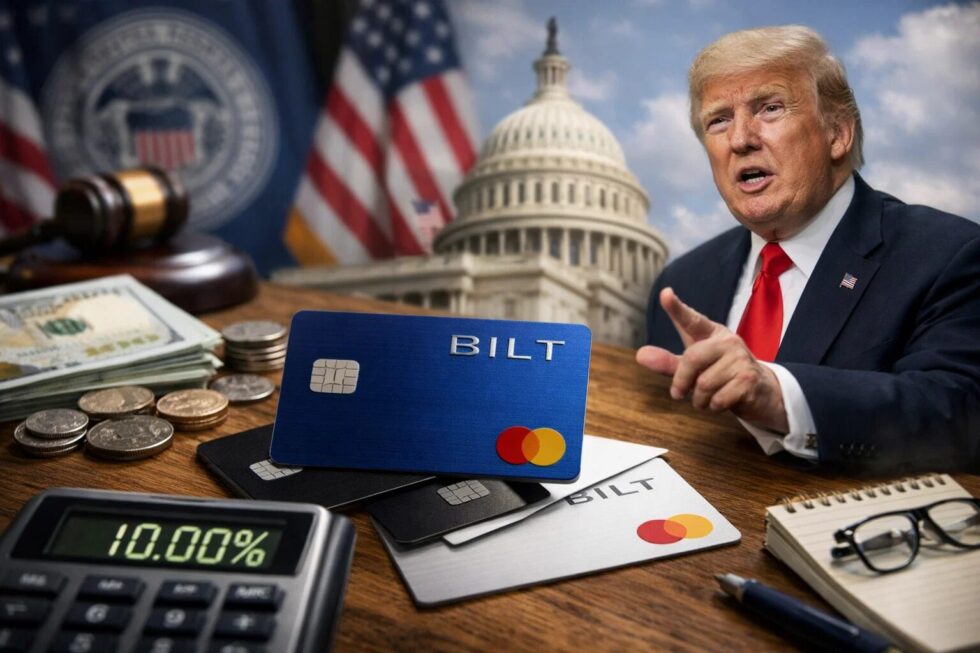
Bilt’s announcement stands in contrast to the resistance expressed by major financial institutions. Executives at several large banks have warned that mandated caps could restrict access to credit and slow economic activity.
How major banks and analysts are responding
Reaction from the broader financial industry has been mixed and, in some cases, openly critical.
At Citigroup, Chief Financial Officer Mark Mason said the proposed cap “would likely result in a significant slowdown in the economy.” Meanwhile, Bank of America Chief Executive Officer Brian Moynihan warned of “unintended consequences” and said such limits would curtail credit availability.
A day earlier, JPMorgan Chase Chief Financial Officer Jeremy Barnum criticized what he described as “weakly supported directives to radically change our business.”
Skepticism has also come from market analysts. KBW analyst Sanjay Sakhrani characterized Bilt’s move as largely promotional, noting that the cap applies only to new purchases on new accounts.
“While this is a headline negative for the industry, as it may be used by the administration to demonstrate the feasibility of a 10% cap, we view this as more of a promotional/marketing ploy from Bilt,” Sakhrani wrote in a note to clients.
Bilt’s new cards: fees, features and conditions
The three newly unveiled cards differ significantly in cost and positioning. Below is an overview of the main terms announced by the company.
| Card name | Annual fee | Introductory rate | Duration | Notes |
|---|---|---|---|---|
| Bilt Obsidian | $95 | Up to 10% APR | 1 year | Premium features, rewards focus |
| Bilt Palladium | $495 | Up to 10% APR | 1 year | High-end tier with expanded benefits |
| Bilt Blue | $0 | Up to 10% APR | 1 year | No annual fee, entry-level option |
All three cards revert to variable rates after the first year. Bilt has emphasized that consumers should pay close attention to post-introductory terms, particularly given how high variable rates may climb.
Changes to rent and mortgage rewards
Alongside the card launch, Bilt is changing how customers unlock and use rewards earned from rent and mortgage payments.
Previously, cardholders were required to make at least five transactions per month to receive points on rent or mortgage payments, regardless of the dollar amount spent. Under the new system, the volume of additional spending determines how many of those housing-related points can be unlocked.
Bilt says the points can be redeemed across a broader ecosystem that includes fitness classes, travel and dining. The change is intended to reward higher engagement rather than a fixed transaction count.
This adjustment is significant for users who rely on Bilt primarily for rent or mortgage rewards, as it introduces a more flexible but potentially more complex earning structure.
Banking partners and the end of the Wells Fargo relationship
The announcement also confirms a major operational shift for Bilt. The company previously disclosed that it would part ways with Wells Fargo, its original banking partner, after building one of the most popular rent-rewards cards in the US market.
Bilt is now running its card program with Cardless, Fidem Financial and bank partner Column. The transition reflects a broader trend in which fintech-driven card programs diversify away from single large bank relationships.
Current Bilt cardholders are required to select one of the three new cards by January 30. Those who do not make a selection will be automatically migrated to a Wells Fargo credit card, according to the company.
Market position, valuation and growth strategy
Bilt was valued at $10.8 billion last year and has continued to expand its footprint among landlords, mortgage providers and merchants. The New York-based firm says it now works with 70% of the top 100 property managers in the US and has partnerships with more than 40,000 merchants.
The capped-rate launch comes as Bilt seeks to position itself as both a consumer-friendly brand and a visible participant in the national affordability debate. While the 10% cap is temporary, it places the company at the center of a discussion that could reshape credit-card economics if regulatory pressure increases.
Where to get official help and information
Consumers seeking clarification about credit terms, affordability or disputes can consult official US consumer-protection resources. Information is typically available through federal consumer finance centers and nonprofit credit-counseling services.
Example support details (for guidance):
National Consumer Credit Assistance Center
Address: 1700 G Street NW, Washington, DC
Hours: Monday–Friday, 9:00–17:00
Phone: +1 855 411 2372
Practical questions consumers are asking
Who qualifies for the 10% cap?
Only new Bilt cardholders opening one of the three new cards. The cap applies solely to new purchases.
Does the cap apply to existing balances?
No. Existing balances and prior purchases are excluded.
What happens after one year?
The APR becomes variable and may rise to as high as 34.74%, depending on conditions.
Are there alternatives with lower rates?
Some banks continue to offer 0% introductory rates for up to 18 months, though these also revert to higher APRs later.
San Francisco News keeps the city, the Bay Area and the wider world informed — with clear, useful reporting on what’s happening, where it matters and what people need to know across technology, business and public life.