



Remote Work in San Francisco: How the Webcam and OnlyFans Economy Is Reshaping Online Freelance
Remote work San Francisco now includes webcam model jobs from home and online studio work. Learn how OnlyFans and streaming platforms operate, industry statistics, earnings models and the growing creator economy. The industry also includes professional studios such as pretty-model.studio, which help new creators enter the market with training, equipment and technical support.

Remote work in San Francisco is usually associated with programmers, startup founders and engineers building digital products for global markets. Yet another online sector has quietly expanded within the same technology ecosystem — the adult creator economy. What began decades ago as a studio-based segment of the entertainment industry has evolved into a global digital marketplace where performers stream, sell subscriptions and interact with audiences entirely online.
Today searches related to remote work San Francisco increasingly intersect with topics such as webcam model jobs from home, working as a webcam model in an online studio, and online adult creator freelance work. The growth of platforms such as OnlyFans, Chaturbate and Fansly has turned adult content into a form of digital self-employment where performers manage their own brand, schedule and income streams while broadcasting to global audiences.
Remote work San Francisco and webcam model jobs from home: how the online creator economy works
The scale of the industry is significant. OnlyFans reported more than 3 million creators and over 220 million registered users worldwide by the mid-2020s. Live streaming platforms such as Chaturbate regularly host 20,000–30,000 live streams simultaneously, with viewers connecting from North America, Europe and Asia. The broader adult creator economy is estimated by market analysts to generate more than $15–20 billion annually across subscriptions, tips and premium content.
Platform economics also illustrate why this sector attracts interest as a form of online work. Most creator platforms operate on a revenue-share model:
- OnlyFans typically allows creators to keep 80% of subscription revenue, while the platform takes 20%. Monthly subscriptions usually range from $5 to $50, though some creators charge more for premium pages.
- Chaturbate and other live-stream platforms rely mainly on tipping systems where viewers purchase digital tokens. One token generally equals about $0.05, and popular performers can receive thousands of tokens during a single broadcast.
- Fansly uses a similar subscription model, with prices typically between $10 and $30 per month, along with additional pay-per-view content.
For many creators the combination of subscriptions, tips and premium content forms multiple income streams. While earnings vary widely, industry reports suggest that successful performers can earn several thousand dollars per month, while top creators with large audiences generate significantly higher revenue. Within this ecosystem several professions support the creator economy:
- webcam models performing live streams
- subscription content creators producing photos and videos
- chat moderators managing live audiences
- digital marketing specialists promoting creator profiles
- studio managers operating streaming facilities
- content editors and photographers producing premium material
Despite the rise of independent creators working from home, professional studios remain an important part of the market. Analysts estimate that 8,000–10,000 webcam studios operate globally. These studios provide professional cameras, lighting, secure internet connections and technical support that many beginners cannot easily access. For newcomers, working as a webcam model in an online studio often serves as an entry point into the industry. Studios train performers in audience engagement, platform algorithms and streaming techniques. After building a following, many creators transition toward webcam model jobs from home, where they control their schedule and manage their content independently.
This hybrid structure explains why the industry continues to expand globally. Remote streaming allows performers to work from almost any location while targeting audiences primarily in the United States and Western Europe. In this sense, the adult creator economy represents one of the most unusual examples of modern remote work — combining live entertainment, social media and subscription-based digital entrepreneurship within the same online marketplace.
The rise of the adult creator economy
Over the past decade the adult entertainment industry has undergone a structural transformation. What was once dominated by centralized studios and production companies has gradually shifted toward independent creators operating as digital freelancers. The change mirrors developments seen across the wider gig economy, where individuals increasingly work through digital platforms rather than traditional employers. The modern adult creator economy rests on three core platform models.
Subscription services such as OnlyFans and Fansly allow creators to sell monthly access to exclusive content. Live-stream platforms such as Chaturbate or Stripchat focus on real-time interaction between performers and viewers. A third model revolves around direct fan monetization through private messaging, custom content and tipping systems.
This structure has turned performers into independent digital brands. Instead of working as employees in a studio system, many creators now manage their own pricing, marketing, audience communication and production. Industry estimates suggest that the global adult creator economy generates tens of billions of dollars annually. OnlyFans alone has distributed billions of dollars in payments to creators since launching its subscription platform, with a large share of revenue coming from users in the United States. Although San Francisco is not a physical production center for adult content, the city remains closely connected to the technological foundations of the creator economy. Many of the tools that power modern streaming platforms — cloud infrastructure, payment technologies, digital analytics and subscription systems — emerged from the same innovation ecosystem that built Silicon Valley.
Why San Francisco matters to the online creator economy
San Francisco’s influence on the webcam and OnlyFans industry is structural rather than geographic. The region sits at the center of the global technology infrastructure that enables subscription platforms, live streaming and digital payments. Several factors explain why the Bay Area remains linked to the expansion of remote creator work.
Technology infrastructure
Streaming platforms depend on complex technical systems. Real-time video delivery, high-capacity cloud servers, global payment processing and content distribution networks make it possible for a single creator to broadcast to thousands of viewers simultaneously. Much of this technology stack was developed within the broader Silicon Valley ecosystem.
Startup mentality
San Francisco’s startup culture encourages individuals to think of themselves as entrepreneurs rather than employees. That mindset strongly influences the creator economy. Many webcam performers and OnlyFans creators approach their work as digital businesses. They track subscriber growth, test pricing strategies and analyze audience behavior using metrics similar to those used by technology startups.
Global digital audiences
Although creator platforms operate globally, a large share of paying subscribers comes from North America and Western Europe, where spending power is higher. As a result, many performers structure their streaming schedules around U.S. time zones and English-speaking audiences, regardless of where they physically live.
Remote work normalization
The pandemic accelerated acceptance of remote work across many industries. Millions of professionals began working from home, and digital freelancing became more common. In that environment, creator platforms increasingly appear alongside other forms of online self-employment rather than as a completely separate category.
How webcam and OnlyFans function as freelance work
From the outside, webcam modeling can appear simple: a performer streams content or uploads photos online. In reality successful creators often run small digital businesses involving multiple roles and daily tasks. Typical responsibilities include:
- Content production – filming, editing and preparing photos or videos
- Live streaming – interacting with viewers during real-time broadcasts
- Marketing management – promoting accounts through social media and online communities
- Audience management – responding to messages and maintaining fan relationships
- Financial administration – tracking revenue, commissions and business expenses
For established performers these activities resemble the operation of a small media production company rather than casual online work.
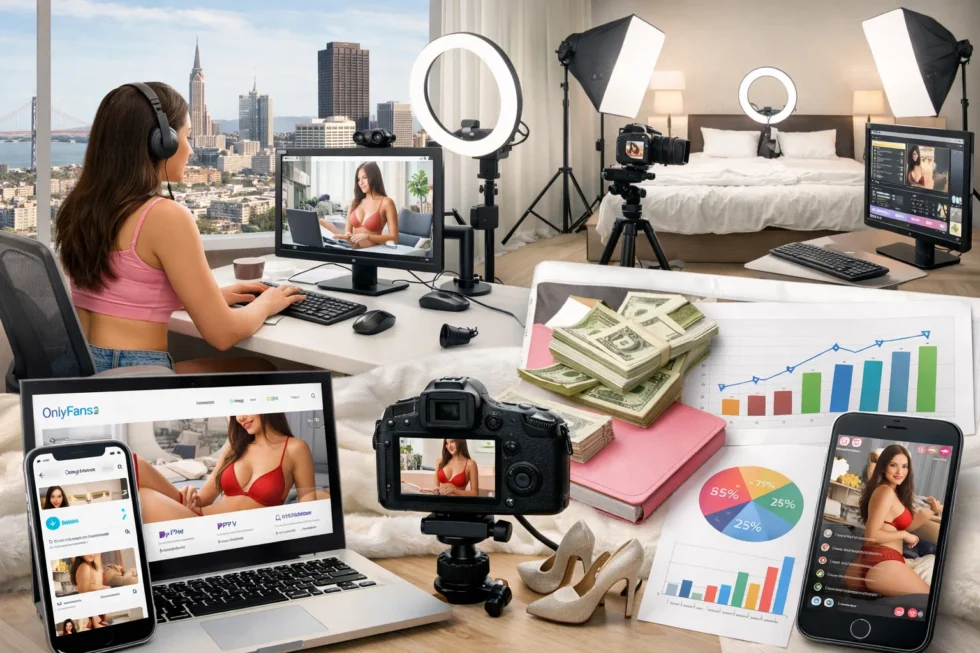
Most platforms follow a revenue-sharing model. OnlyFans, for example, retains roughly 20 percent of creator income while around 80 percent goes to the performer. Webcam platforms use comparable commission systems, with revenue generated through several parallel streams such as subscription fees, tips during live streams, pay-per-view messages, private sessions and custom content requests. Because platform traffic fluctuates, many creators maintain accounts on several services at once. Diversifying across multiple platforms helps stabilize income and reduces dependence on a single website.
The economics behind online adult platforms
Income in the creator economy varies dramatically depending on audience size, marketing ability and niche positioning. While many creators earn modest side income, others build large subscription audiences that generate substantial monthly revenue. Typical income ranges observed across platforms include:
| Creator level | Typical monthly earnings | Description |
|---|---|---|
| Beginner | $200 – $1,000 | Small audience, early growth stage |
| Developing | $1,000 – $10,000 | Growing subscriber base |
| Professional | $10,000 – $50,000 | Full-time creator with strong brand |
| Top creators | $50,000+ | Highly visible accounts with global audiences |
These figures vary widely, but they illustrate how the business model relies on audience relationships rather than traditional distribution. Viewers often pay for personalized interaction rather than simply consuming content.
Digital marketing as the engine of creator success
Behind most successful creators lies a structured marketing strategy. Contrary to common assumptions, subscription platforms rarely generate large traffic for new accounts automatically. Visibility must usually be built through external channels. Common marketing tools include:
- X (formerly Twitter), widely used in the creator community
- Reddit niche forums where audiences already seek specific content
- Instagram profiles used for brand visibility
- short-form teaser videos on TikTok
- direct messaging systems for subscriber retention
- personal websites or blogs capturing search traffic
In practice many creators spend as much time building audiences as producing content. Profiles, posting schedules and visual style are managed carefully to maintain engagement and subscription retention.
Legal and regulatory considerations in the United States
Adult content production in the United States is legal but strictly regulated. Creators and studios must comply with federal laws on age verification, documentation, taxation and platform rules. Anyone working as a webcam model or online creator must understand these legal requirements before entering the industry.
Age verification
Federal law requires documentation confirming that all performers appearing in adult content are at least 18 years old. Platforms enforce identity verification procedures before allowing creators to publish content.
Platform compliance
Creator platforms maintain internal rules regarding acceptable content, copyright, consent and community standards. Violations can result in account suspension.
Tax obligations
Most creators are classified as independent contractors. They are responsible for declaring income, paying taxes and managing business expenses related to their work.
Payment processing limitations
Adult businesses often face restrictions from traditional financial institutions. As a result, specialized payment systems and platform-based financial tools have developed to handle transactions. For international creators targeting U.S. audiences, navigating payment systems, taxation and platform policies can become complex and often requires careful planning.
Psychological and social aspects of webcam work
Working in the creator economy requires technical skill as well as emotional resilience. The work involves constant online visibility and direct interaction with audiences. Common challenges reported by creators include:
- harassment or trolling on public platforms
- privacy risks and exposure of personal information
- managing boundaries with fans
- social stigma associated with adult content work
At the same time many creators emphasize the advantages of flexible schedules, remote work and the ability to control their own income streams. Experiences vary widely depending on personal boundaries, support networks and working conditions.
Common mistakes new webcam creators make
Many people searching online for how to become a webcam model or webcam model jobs from home underestimate how structured and competitive the industry has become. Successful creators rarely treat streaming as casual online activity. In practice it operates like a small digital business where branding, marketing, pricing and audience management determine long-term income. Several mistakes appear repeatedly among beginners entering the webcam and subscription platform market.
Lack of personal branding
Many new creators publish content without a clear identity, niche or recognizable style. In a market where thousands of performers stream simultaneously, audiences tend to remember personalities rather than random accounts. A defined visual style, tone of communication and content niche significantly increase the chances of building a loyal subscriber base.
Ignoring marketing and traffic sources
A common misconception is that platforms automatically send viewers to new accounts. In reality most successful creators generate a large share of traffic through external promotion. Social media platforms, niche communities and search visibility often play a larger role in audience growth than the internal algorithms of streaming platforms.
Unrealistic pricing strategy
Beginners often set subscription prices too low in an attempt to attract followers quickly. While this may increase early subscriber numbers, it can reduce overall revenue and make it difficult to adjust pricing later. Experienced creators usually test different pricing levels to balance accessibility and long-term profitability.
Weak privacy protection
Failing to separate personal identity from professional activity is one of the most serious risks for new performers. Using real names, revealing identifiable locations or linking personal social media accounts can expose creators to privacy issues that are difficult to reverse later.
Burnout from constant content production
New creators sometimes assume that posting large volumes of content guarantees success. In practice sustainable growth depends on consistency and audience engagement rather than sheer quantity. Excessive production without structured schedules often leads to fatigue and declining quality. For newcomers comparing webcam model jobs from home with working as a webcam model in an online studio, these challenges illustrate why preparation matters. Understanding branding, marketing, pricing and privacy management can significantly improve the chances of building a stable and sustainable career in the creator economy.